
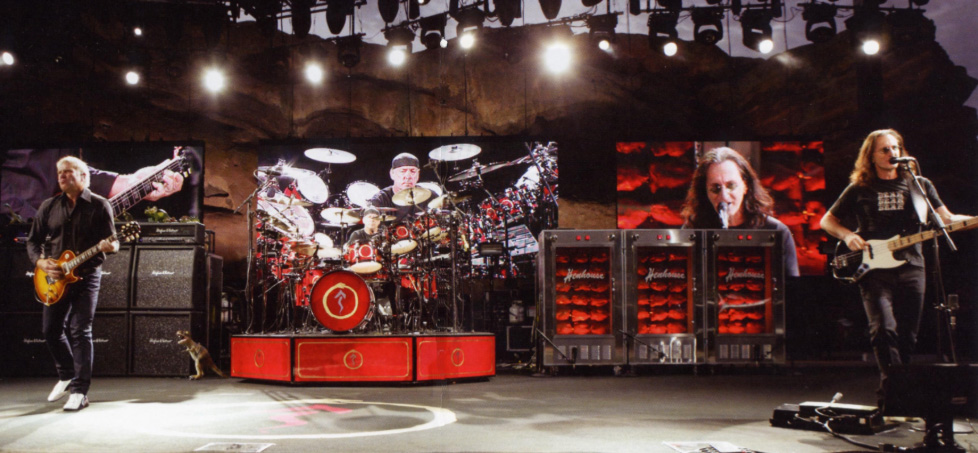
Originally published in eight parts in June 2007 at BigBlueBullfrog.com, this article tells the biography of Rush while giving the play-by-play of a concert on the Snakes and Arrows tour.
~
Tonight I am with Veggie, my friend and fellow musical connoisseur, as we step out of the mundane valley of everyday life towards the mountain of artistic possibilities. We each bring two sons to witness the ceremony of the grand oracles of audio. Decades have rolled by and many of the mighty have fallen into the echo a chamber of the past, but Rush persists in grand competence and in original form.
For Veggie, this is the tenth time he has seen Rush live, while for me it is merely my fourth. The only other “repeat offender” in the group is my 16-year-old son, The Meister, who joined us during Rush’s 30th anniversary tour in 2004. That show was so excellent that I caught another at Radio City Music Hall a few weeks later, the only time I’ve ever saw the same band twice on the same tour. The other three members of our party, Veggie’s two teenaged sons (“the Green Veggies”) and my own 9-year-old boy, Mr. Rooski, are all rookies to the experience.
Part I: A Long Awaited Friend
Leading up to my first Rush concert in 1992, I was assured by Veggie that I would be disappointed because they play all “new” stuff. This being defined as anything released post Moving Pictures (1981) when Rush’s music changed from classic rock to new wave and beyond. But for their second song rang the familiar riff of “Limelight”, from that very benchmark album. I remember the charge it sent into the air as well as the relief I felt that Veggie had actually been wrong about the lack of classic material.
Coming into this show, I knew “Limelight” would be the first song, and Mr. Rooski was especially excited because this was his favorite. So it was, the anticipation built as the last intense rays of summer sun flooded our eyes with white hot light. The tension built as the roadies climbed the rope ladders to the overhead lights and someone hit an errant chord through the system.
Then during the introductory movie, two separate clips featuring our heroes in comedy routines, I spotted Alex Lifeson stage right awaiting his sequenced appearance and that familiar riff of “Limelight”. As the fever built to a crescendo, the heroes fully emerge on the stage but the sound – fell both off time and flat, first due to the late arrival of Geddy Lee but then to the phasing of Alex’s low end on the axe. Although the crowd, standing and shouting, responded with enthusiasm, there was no doubt something was just a little “off”, which may be expected from your run-of-the-mill rock bands but never from the masters known as Rush.
The crescendo had collapsed into a tinge of bewilderment and disappointment although, not a totally unpleasant experience. Sort of like bad sex where you know it should be much better, but you can’t bring yourself to stop anyway. Even though the impressive effect of the three large overhead digital screens each focused on a member of the band, there seemed to be a pained flight against the jet stream that I had not witnessed from these guys before. These guys are usually the architects of the jet stream itself. Nevertheless, “Limelight” concluded to thunderous applause through the calm dusk by the most loyal fans in rock n roll.
After the short pause (segues would be absent tonight), Neil Peart rolled into “Digital Man”, a more obscure track from 1982’s Signals, the most new wave flavored of the band’s 18 original studio albums and one that I have been gaining more respect for as I mature in my audio tastes. The song itself works well to counter-balance the disappointment of the opening number. Equal parts funk, reggae, and rock, the performance introduces a fresh arrangement of an already obscure song. Also, I personally like the injection of exotic locations Avalon, Babylon, and Zion into the lyric (who has ever done that before or since?)
Perhaps it’s because of our unfamiliarity or because our expectation are lower, but the sound quality appears to improve ever-so-slightly during this number. Maybe it was just the lack of an opening act or the sound man caught sleeping after all.
Part II: Alone and Yet Together Like Two Passing Ships
The popularity of 1981’s Moving Pictures brought Rush exposure to many new “mainstream” fans like the 13-year-old version of myself. Hence, that became the starting point and reference against which I’d gauge the subsequent albums. It wasn’t until years later that I (with the great help from the already seasoned Veggie) would realize that Moving Pictures (Rush’s 8th studio album) was, in fact, the culmination of the extraordinary early work (or “classic work”) of this band. I then began to discover the true classics, Fly by Night, Caress of Steel, 2112, and Permanent Waves.
Released on January 1, 1980, Permanent Waves is a true gem of an album that has stood the test of time. A testament to that fact is that tonight, 27 1/2 years later, Rush performed four out of seven of the tracks from hat album starting with the rarely-performed “Entre Nous” for their third number of the night. Looking forward with Internet-provided set list in hand, this is the first big interesting highlight of the show for me. Unfortunately, this turned out to be the time that the drunken jackass in front of me had a seat dispute and for a moment looked like he was trying to overtake The Meister’s seat. Naturally, I was not able to view the performance with more than one eye but was still able to be impressed by Lifeson’s seamless transition between electric-on-strap and acoustic-on-stand during the chorus’ refrain. The tune, title French for “between us”, has always been a peculiarly overlooked gem in my opinion, especially since it’s as easily accessible and pop-oriented as the wildly-popular “Closer to the Heart” (which the band mercifully “retired” a few tours back). But being one who generally appreciates a “dark” gem over any “common” anthem of comparable quality, I was thrilled to be able to experience this song on this night as I discovered for the first time how well constructed is the mid section with nice chord progression.
The next song was “Mission” off of 1987’s Hold Your Fire. Admittedly, I knew nothing of this song until about a week ago when I dug it out of my mp3 archives, Rush being one of the elites which I must have a copy of every single recording they ever made. Even so, Hold Your Fire, has remained an undiscovered country beyond “Force Ten” and “Time Stand Still”. Still, this sounded interesting enough on the original recording, and an astute ear predicted that this might sound quite well live when all of the 80’s production gunk is lifted to reveal the core jam. This prediction materialized nicely and the song, which switches between church-organ-like sustained keys to full-throttle rock jam, was well received as the band completed its opening eclectic quad with the sound quality in the amphitheater gradually improving.
Part III: A Ready Guide in Some Celestial Voice
I remember being just a bit hesitant when Veggie originally invited me to see Rush’s 30th Anniversary Tour in 2004. I was in the middle of selling a house and relocating and really had no time or energy to pay homage to old rock n roll. Besides I had done the Rush “thing” back in ’92 and hadn’t been totally impressed by the material they had put out since. Still, Veggie persisted along the lines of this being a “special” anniversary tour in which they would play music from all their albums, including the great classics from the seventies. Further, this was about the time that the then-13-year-old Meister was starting appreciate a lot of great classic rock including Rush and I saw a great bonding experience in going. So the three of us, Veggie, The Meister, and me, went to a rock concert in August ’04, then came the show.
The band members, just on the far side of 50, put on a spectacular 3-hour gala with some unbelievable selections (By-Tor and the Snow Dog!). The performance spanned their 30-year career nicely (with the exception of Presto being omitted) and was absolutely flawless in tone, texture, and execution. They did not reach that level of performance tonight until their fifth number, “Freewill”.
The second selection from Permanent Waves, “Freewill” is the quintessential Rush song from their classic era. It has an odd-yet-melodic riff and chord structure with an easily accessible chorus line yet with deeply philosophical lyrics that read as much like an analysis as an argument. Then there is the jam – the bass-lead mid section that takes this song to the next level. Rush played a lot of great songs tonight and most of them well, but none as well as “Freewill”. This was the best performance of the night, and this was the song when I fully realized how far reaching these musical geniuses grasp. To the left of me, standing on his chair was Mr. Rooski, to the right Veggie. The divergent yet equal enthusiasm of the 9-year-old child and the 42-year-old old man, one was trying to learn while the other remembering how to conduct oneself at a rock concert. And Rush is the true rock concert.
On stage, Pert went nuts and the crowd erupted and Rooski played his “air” drums as the mid section flawlessly descended back into final verse. Lee’s voice, a bit questionable earlier, was in full throttle for the soaring final verse. As the song concluded to thunderous applause, Lee addressed the crowd for the first time by introducing “The Main Monkey Business”, an instrumental and the first selection from their latest album Snakes and Arrows.
Although not in the league of classic Rush instrumentals such as “La Villa Strangiato” or the “2112 Overture” from their classic seventies era, this is still a good jam crafted by the 50-somethings of today. A comic and surreal video collage of posturing, dancing, and copulating primates adds a touch of levity to the experience. Comedy always being a staple of the Rush performance, they up the ante with a short film by those classic Canadians The McKenzie Brothers that introduces another Snakes and Arrows number “The Larger Bowl”.
“Secret Touch”, a gem from 2002’s Vapor Trails followed with yet another stunning performance of a song made for the stage. The show as a whole had seemed to find its groove as the crowd echoed the dynamic lyrics of the verse, “…the way out is the way in…” and moved and shook to the earth bouncing groove. Even the three teens in our party, Mr. Meister and The Green Veggies, while simultaneously trying to act too cool for school, could not help but to outwardly express their delight.
Part IV: Sometimes in Confusion, I Feel So Lost & Disillusioned
Although Rush definitely jams, they defy nearly all conventions of the conventional “jam band”. This is especially true in their rigid consistency of their set list once chosen. In fact, in 2004 they played every single show exactly the same, despite playing over 32 songs that spanned three decades. So, like seeing a movie over again, both shows I saw of that tour were exactly the same, but I was able to pick out finer details the second time through. Hey, if it ain’t broke! But knowing this, like the kid who partially unwraps the gifts under the tree, I couldn’t help but cheat and get their set list online. This set to act as a primer on one hand, but perhaps launch some unrealistic expectations on the other. For as a mulled over the familiar and unfamiliar on the list, one song jumped out with the greatest expectation, “Circumstances”.
A gem from 1978’s Hemispheres, this is a unique and dynamic tune that equally delights the ears of the astute listen but frustrates the fingers of the budding musician. With its classic, French to English refrain;
“Plus ça change, plus c’est la même chose,
the more that things change, the more they stays the same”
The perception of this song live – not played in front of an audience in more than two decades – was astounding, but the reality of it tonight was disappointing.
Performed in a lower key register, but yet with drop-off vocals, the song at times sounded like an LP being slowed by a child’s finger (for those of us that remember such things). And although the mid section, with the dual lead from Peart’s xylophone and Lee’s synthesizer, that leads into a classic riff descension by Lifeson was still a great delight, “Circumstances” as a whole was a disappointment from a source that rarely disappoints.
The band finished their first set with 1984’s “Between the Wheels” and 1991’s “Dreamline” and the show seemed to lose momentum that was built during the excellent middle of the set. Although both decent tunes and holdovers from the 30th anniversary tour, they felt like filler material when compared against some of the songs that could have been here (“Red Barchetta”, “Fly by Night”, “2112”, “The Pass”, – I can go on and on). While the former felt like a nice vintage pick in 2004, it revealed itself tonight as a mediocre song from a mediocre period of the band, especially accented with Lifeson’s out-of-tune axe. The latter brought out the green lasers and nostalgia for that first concert in ’92 but that could have been fulfilled nicer by a number of songs such as “Red Sector A” or “Force Ten”. But perhaps this was prophetic with the lyric “we’re only immortal for a limited time” during the song and Lee’s announcement “we’re old, we need a break, we’ll be right back” after.
Part V: Pariah Dogs & Wandering Madmen
About a year after seeing their 30th reunion tour, I was pleasantly surprised when Mr. Rooski, then about 7, started to boost that his favorite band was Rush. He soon secured a promise from me that we would go see them and he could tag along. So in early 2006 we began to investigate, via Internet, just what future plans Rush were making to which we found a post that announced they were taking the entire year of 2006 (they’re fifty-something and taking an entire year! WOW!) to record a new album and would probably be back on the road in ’07. So it was that we waited, is Rooski’s favorite song shifted from “Time Stand Still” to “Limelight” and he regularly bugged me to burn him another Rush CD with this song or that song included.
Throughout the early part of this year there was buzz that the album was in fact finished and that it was a masterpiece. Then on May 1 the new album, Snakes and Arrows, was finally released, the first (and likely only) non-Camelot-centric CD that I purchased this year. After a few listens I was convinced that this would rank among the best Rush albums ever (there are 18). With 13 tracks, some of considerable length, this may have been a double album back in the day (although Rush never released a double studio album) but it quality throughout. No track, including the three instrumentals, can be considered “filler” or “throw away” and the richness of original phrases and themes is astonishing (including my favorite, the title of this article from the great song “Armor and Sword”). For two months this has been spinning in my car’s deck and still, with each listen, new lyrical and musical nuggets are mined. I was excited to find out that they would be performing nine of these tracks on this tour (yet, amazingly, disappointed in the four that were omitted – that’s how good this album is).
So it was that the heart of the concert, which concentrated most on Snakes and Arrows, was the beginning of the second set. After a weird and comical short film starring Lifeson, the band exploded into the album’s first song, “Far Cry”, which included e an excellent audio performance and excellent stage effects, between the video and the coordinated fireworks that launched immediately after the lyric “you can almost feel the circuits blowing”. Being released as a “single” in early March, this is the most recognizable of the new songs, which was reflected by the enthusiasm of the crowd. Also, the sound problems that were evident in the first set seemed to have dissipated during these first few songs of the second (though it would reemerge later).
This was followed by Rooski’s favorite new song, “Workin’ Them Angels”, which in turn was followed by the Meister’s new favorite “Armor and Sword”. The former is a companion to Peart’s latest literary effort, which tells of him driving cross-country and listening to “the soundtrack of his life”, and is unique musically in featuring a mandolin solo by Lifeson. The latter blended Lee’s animated bass line behind Lifeson’s acoustic reminiscent of the classic “The Trees”, although this new one seemed to go to a bittersweet plane never before reached.
The quintet of Snakes and Arrows songs was wrapped up by two more fine songs, “Spindrift”, which is almost a classic heavy metal style song, with its dark mood and repetitive drilling, and “The Way the Wind Blows”, which features some of the finest melodic vocals by Lee. Although the inclusion of these was certainly appreciated by those of us who own (and are well-versed in) the album, it was becoming apparent that many in the crowd did not and the vibe hit a lull. Perhaps five new songs in a row, fresh off a 20-minute break, was not the best sequencing (and later there would be worse).
Part 6: In Between the Bright Lights & the Far, Unlit Unknown
At this point actually sitting down for probably the first time tonight, Rooski and I were immediately brought to our feet (well, in his case, on top of a chair) by the deep, driving synthesized bass notes that initialize “Subdivisions”. This song, fast becoming a concert classic, sparked an immediate charge into the audience and, like with “Freewill” earlier, Rush was again into stratospheric form.
This song is from 1982’s Signals, which was the immediate follow-up to the fantastic Moving Pictures. I long resented this album as the point where Rush made a sharp turn from their classic phase, in which they built and built towards the Moving Pictures crescendo, into the realms of New Wave and beyond. In recent years, however, I have come to regard this album due to it’s unique mixture of reggae, classical, and early 80’s pop along with still-present elements of classic Rush riffs and drum textures. It’s funny how songs mature over the years.
The concert’s momentum continued with “Natural Science”, a vintage and peculiar extended piece that starts with rather mundane acoustic intro verses but soon kicks into classic jam from heart of classic Rush era. Visually stunning with animation depicting DNA strands and wormholes, fit in well with the tempo and mood which is spawned by lyrics about complete societies formed in microcosmic planets within the pools on a rocky shore, deep philosophical science fiction with a driving rhythm – fantastic!
The haunting chimes and eerie strings form an extra-long intro to “Witch Hunt”, a long time favorite of both Veggie and the Meister. The crowd roars as giant flames accompany the lyric “lonely, torch-lit hill” and the overhead screen show “faces twisted and grotesque”. This song makes a welcomed concert comeback after two decades in hiatus, rounding off the most interesting sequence of the show.
Part 7: Shatter the Illusion of Integrity
The stars were aligned as we climbed the hill into Montage Mountain tonight. Rush had been as close to perfect as possible 3 years ago, but neither Rooski nor the Green Veggies had been there to witness that performance. Since then, the band had produced their best album in a quarter century and was now back for all of his witness. In the parking lot before the show, their was pure excitement and bliss as Giants and Cowboys fans put aside their petty differences and join in rare agreement about the holiness of this band (as well as the wretched evil of the Philadelphia Eagles). The kind of audience that can only encompass the seats at a Rush concert. On the album Hold Your Fire, there is a song “Tai Shan” which speaks of climbing the sacred mountain of 7,000 stairs which will bring 100 years of life. I openly professed before the show that this may, in fact, be the case – that perhaps they are barely halfway through life (and yet to reach the halfway point of their careers).
But tonight they seemed human and, yes, even showed their age. Further, the hodgepodge of order to their selections was baffling to the audience, especially during the MalNar/Drums/Hope/Summertime Blues sequence. Taking separately, or put in more proper order, there is nothing terrible about any of these selections, but tonight (with the exception of the internal part of Peart’s drum solo) it felt confused. “Malignant Narcissism” is a short, bass-dominated instrumental that would have worked better as a mid section to an established song (as would the drum solo, which Veggie astutely pointed out belongs inside “YYZ”). “Hope” is a pastoral acoustic solo by Lifeson that would be a nice intro to another acoustic-dominated song (which Snakes and Arrows has many) but instead led to the Feedback cover “Summertime Blues”, which fell flat in this sequence. How many great originals were passed over for this one? Aside from its placement, the drum solo was fantastic as usual and included some unusual pairings (via overhead screen) with classic jazz and big band greats. Rooski, who wants to someday be a drummer himself, played his air drums throughout.
Further the sound problems, evident in the first set, had returned as the band launched into the fourth and final selection from Permanent Waves, the normally-fantastic “Spirit of Radio”. The high end of the bass was drowning out the low-end of the guitar, and the tuning was just a bit off. However, Pert was still there keeping perfect time and the crowd loved it anyway.
Part 8: Changes Aren’t Permanent, But Change Is
Rush is a pure Canadian group out of Toronto, where they live and work to this day. But their true break though to reach an American (and then worldwide) audience was in Cleveland, Ohio where, just like the story of rock-n-roll itself, an influential disc jockey got hold of their earliest material and revealed it to a much wider audience. This ironic fact makes it all the more shameful that Rush has not been inducted in the Rock n Roll Hall of Fame right there in, Cleveland. When I first visited the Hall five years ago, this was an absolute shock to me, especially when I learned of the volume of marginal talent that actually IS in the H.O.F. Over time, I have come to accept that this monument is little more than an elaborate sham than arbitrarily excludes any act that hints of progressive rock or virtuosity. In other words, when it comes to induction credentials, music itself is not only considered unimportant but its mastery may actually serve to disqualify a group. Couple this with the narrow political and elitist agenda of the prime movers, and the HOF has in many ways become the antithesis of the true spirit of rock n roll. So I have come fully around to actually hoping that Rush never enters the Rock n Roll Hall of Fame because it is no longer a question of whether Rush deserves the honor, but whether the Hall deserves Rush.
After a comical bit featuring the animated stars of South Park, Rush launched into their most popular song ever “Tom Sawyer”. This was the first Rush song I ever heard and I thoroughly enjoyed its original structure and theme when I was thirteen. Due to my innate bias against overly commercialized pop songs, I sort of dismissed this song as sub-par to its counterparts for most of my subsequent tenure as a Rush fan. Tonight I rediscovered “Tom Sawyer” as for about four and a half minutes; I experienced this song like I did when I was a kid. Onstage, with Lee seamlessly switching from keys to bass, Pert pounding with a purpose, and Life son blissfully grooving, arms up in the air, there was an energy and enjoyment onstage that I hadn’t associated with “Tom Sawyer” before.
So it was that the band said goodnight. Although they did return for their (per-fabricated) encore which featured the decent but forgettable “One Little Victory”, “A Passage to Bangkok”, and “YYZ” (sans drum solo), the “Tom Sawyer” performance completes the circle nicely for me.
Over the past 33 years have these masters molded their song craft by the frozen lakes of the great white north, and then visited our cities to perform the true master craft with great precision and euphoria. Three years ago the celebrated their 30th anniversary with concise renderings that spanned each diverse jewel, tonight, not so much. They showed just the slightest hints of age and confusion, something unheard of in the shows of yesteryear. In ’04 they were still gods, untouched by the ravages of time, tight and in tune. This show was badly produced (Veggie suggested they should can the sound man on the spot), especially when compared to ’04. There was a sense then of continuity and connection with the past. The humor was strategically placed and the sequence was robust. Tonight, the sound was lacking.
All this being said, this was still one of the most enjoyable concert experiences I’ve ever had. At 9, it was Rooski’s first, and he lost his bet with me that he would be the youngest one there. The Meister filled his PSP with all Rush mp3s and in chronological order, so he could scholarly explore every song in preparation. Veggie, who has all but abandoned rock-n-roll in favor of hardcore blues, also got to bring his sons to see this enduring phenomenon known as Rush.
As for the band itself, they are a unique entity in entertainment history; consistent in lineup, yet ever-evolving in musical direction, all the while sustaining a mutual loyalty with their fans and never capitulating to the bluffers and posers in the Rolling Stone magazine-approved mainstream. They are musician’s musicians whose body of work transcends time will be studied, listened to, and enjoyed by generations to come. As they slide towards senior-citizenship, it might be tempting to say that they are in twilight of their career, but I wouldn’t bet on it.
~
Ric Albano, 06/28/07

The Rush Story
Top Ten Great Forgotten Rush Songs
Rush Discography
Burn Down the Rock Hall of Fame!